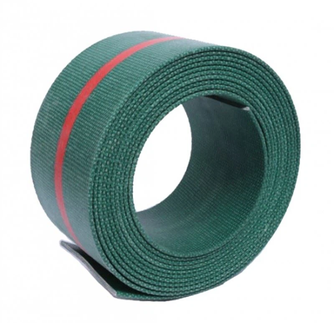
I. Overview of Core Parameters and Characteristics for Two Types of Belt Drives
|
Comparison Dimension |
(friction type - trapezoidal cross-section) |
(friction type - rectangular cross-section) |
|
Transmission Principle |
Wedge-shaped friction between belt sides and pulley groove |
Planar friction between belt inner surface and pulley face |
|
Core Advantages |
High load capacity, cost-effective, overload protection |
Excellent flexibility, suitable for multi-pulley/directional transmission, high installation tolerance |
|
Primary Disadvantages |
Variable transmission ratio (2%~5% error), high shaft compression force |
Low power transmission capacity (≤5kW), prone to slippage |
|
Transmission Ratio Accuracy |
Moderate (elastic slip + slippage) |
Low (planar friction prone to slippage) |
|
Power Transmission Range |
0.5~70kW (standard V-belt), 1–100kW (narrow V-belt) |
0.1~5kW (single belt) |
|
Applicable Belt Speed |
≤25m/s (standard V-belt), ≤30m/s (narrow V-belt) |
≤15m/s |
|
Preload Requirement |
High (requires sufficient friction to prevent slippage) |
Significant (flat friction requires high pre-tension) |
|
Cost Level |
Medium (¥10~50 per belt) |
Low (¥5~30 per belt) |
|
Typical Service Life |
1000–2000 hours (standard V-belt) |
800–1500 hours (rubber flat belt) |
II. In-depth Analysis of Advantages and Disadvantages for Two Belt Drive Categories
1. V-belts: The 'Practical Choice' for Medium Power, High Cost-Effectiveness

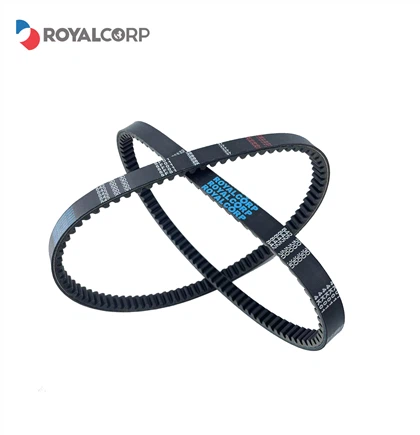
Advantages
· Strong load capacity: Wedge-shaped friction amplifies friction force, enabling a single V-belt to transmit 2~3 times the power of a flat belt of the same width, suitable for low-to-medium power applications (e.g., water pumps, fans);
· Cost-effectiveness champion: Low procurement cost, simple maintenance, replacement of a standard V-belt costs only around ten yuan, ideal for equipment requiring bulk usage;
· Built-in overload protection: Slips under excessive load to prevent motor, gear, and other core component burnout, offering high fault tolerance;
· Wide adaptability: From domestic washing machines (Z-type V-belts) to industrial fans (D-type V-belts), covering 0.5~70kW power ranges with comprehensive model availability and ease of procurement.
Disadvantages
· Low precision: Elastic slippage causes transmission ratio errors of 2%~5%, rendering it unsuitable for precision drives (e.g., machine tool spindles);
· High shaft loading: Requires high preload to prevent slippage, exerting radial pressure on pulley shafts and bearings 2~3 times that of synchronous belts, potentially shortening bearing life;
· Short lifespan: Rubber material is prone to ageing; standard V-belts last only 1~2 years and require periodic tension adjustment (every 3 months);
· Vulnerable to oil contamination and high temperatures: Oil corrodes rubber and reduces friction coefficient; temperatures above 80°C accelerate ageing, necessitating avoidance of harsh environments.
2. Flat belts: The versatile solution for multi-pulley drives and complex layouts

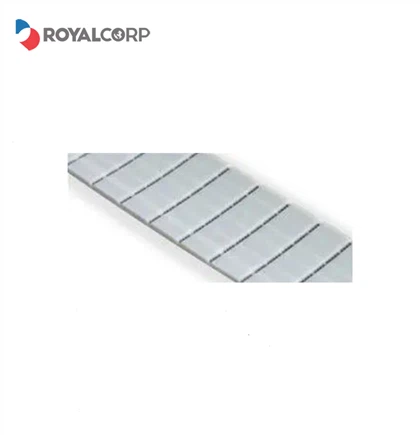
Advantages
· Flexible layout: Suitable for multi-pulley drives (a single belt driving three or more driven pulleys) and directional changes (90° turns), ideal for complex machinery like textile looms and printing presses.
· Excellent flexibility: Thin-profile design accommodates small-diameter pulleys (minimum diameter≥20mm), making it more suitable than V-belts for compact equipment (e.g., miniature conveyors).
· High installation tolerance: accommodates ±2° shaft misalignment without precise alignment, enabling swift installation even by novices;
· Hygienic and odourless: smooth polyurethane surface facilitates easy cleaning, suitable for food and medical applications (e.g., biscuit production lines, IV set assembly).
Disadvantages
· Limited power transmission: Despite extensive flat friction contact area, its friction efficiency falls short of V-belts' wedge effect. Single-belt power capacity ≤5kW; multiple belts required for heavy loads;
· Prone to slippage: Tends to slip under low speeds or heavy loads, with transmission ratio errors of 3%~8%, unsuitable for applications demanding precise speed control;
· Sensitive to tension: Insufficient pre-tension causes slippage, while excessive tension accelerates belt stretching and ageing, necessitating frequent checks and adjustments (every 2 months);
· Demanding pulley requirements: Pulley surfaces must be smooth (roughness Ra ≤ 1.6μm), otherwise the flat belt's inner surface wears easily, increasing maintenance costs.
III. Precise Application Matching for Two Categories of Belt Drives
|
Belt Type |
Core Application Scenarios |
Typical Equipment Examples |
Selection Priority (Scenario Matching) |
|
Medium-low power transmission (0.5–70kW); Equipment requiring overload protection; Low-cost, high-volume usage scenarios |
Water pumps, fans, machine tool spindles (low-precision models), domestic washing machines |
Medium power > Cost-effectiveness > Overload protection |
|
|
Multi-pulley / direction-changing transmission; Small conveying equipment; Food / medical cleanliness scenarios |
Textile machinery, printing presses, food sorting lines, miniature conveyors |
Complex layouts > Cleanliness requirements > Light loads |
IV. Selection Decision Tree
1. Step One: Assess Power Rating
· Power > 5kW → Select V-belt (narrow V-belt);
· Power 1–5kW → Select V-belt (standard V-belt) or flat belt (heavy-duty flat belt);
· Power < 1kW → Proceed to Step Two.
2. Step Two: Evaluate Equipment Layout and Space
· Multi-pulley transmission, directional changes required → Select flat belt;
· Standard light loads, prioritising simplicity → Select flat belt.
Selecting V-belts: Remember 'medium power, high cost-effectiveness'. Suitable for general equipment like pumps and fans requiring overload protection with budget constraints.

Selecting flat belts: Remember 'complex layouts, cleanliness requirements'. Suitable for multi-pulley drives or food processing scenarios, where slightly lower power limits are acceptable.