
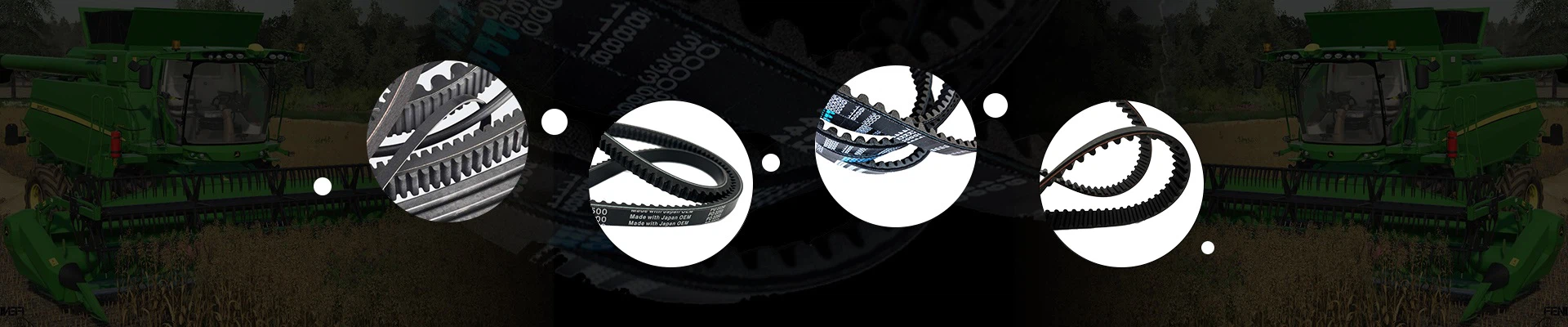
Industrial belts are a type of transmission device widely employed in industrial production, extensively utilised within the conveying and transmission systems of various mechanical equipment. The designation of an industrial belt typically comprises a series of numbers and letters, wherein the letters denote the belt's type and the numbers indicate its specifications, such as length.

The first digit in an industrial belt model number usually denotes the belt's width. This figure, measured in millimetres, indicates the width of the belt within the transmission system. A larger number signifies a wider belt, while a smaller number denotes a narrower belt. Belts of varying widths can be selected according to specific transmission requirements and equipment characteristics.
The second digit in an industrial belt model typically denotes the belt's thickness. This figure is also measured in millimetres, indicating the thickness of the belt's cross-section. A larger number signifies a thicker belt, while a smaller number indicates a thinner belt. The belt's thickness determines its load-bearing capacity and the magnitude of power transmission it can handle.
The third digit in an industrial belt model usually indicates the belt's length. This figure is usually measured in metres and indicates the closed-loop length of the belt. Belt length can be selected according to specific equipment requirements. Longer belts accommodate broader transmission ranges, while shorter belts suit smaller transmission units.
Additional digits or letters may follow the industrial belt model number, denoting special characteristics or materials. For instance, the letter 'V' denotes a V-belt, while 'S' indicates a synchronous belt. Numerical components often signify the number of layers or structural configuration.
In the model 'B1500', for example, "B" represents a B-type belt, and '1500' specifies a length of 1500 millimetres. Industrial belts are primarily categorised into two main types: standard industrial belts and narrow V-belts. Standard industrial belts encompass multiple models including O, A, B, C, D, 3V, 5V, and 8V, while narrow V-belts comprise four models: SPZ, SPA, SPB, and SPC.
The numerical components of industrial belt model numbers denote the belt's width, thickness, and length, which determine its applicable range and load-bearing capacity. When selecting an industrial belt, one must choose an appropriate model based on specific transmission requirements and equipment characteristics to ensure stable operation and efficient performance of the transmission system. Different industrial belt models are suited to distinct transmission devices and application fields; therefore, comprehensive consideration of all factors is essential during selection to meet practical requirements.