
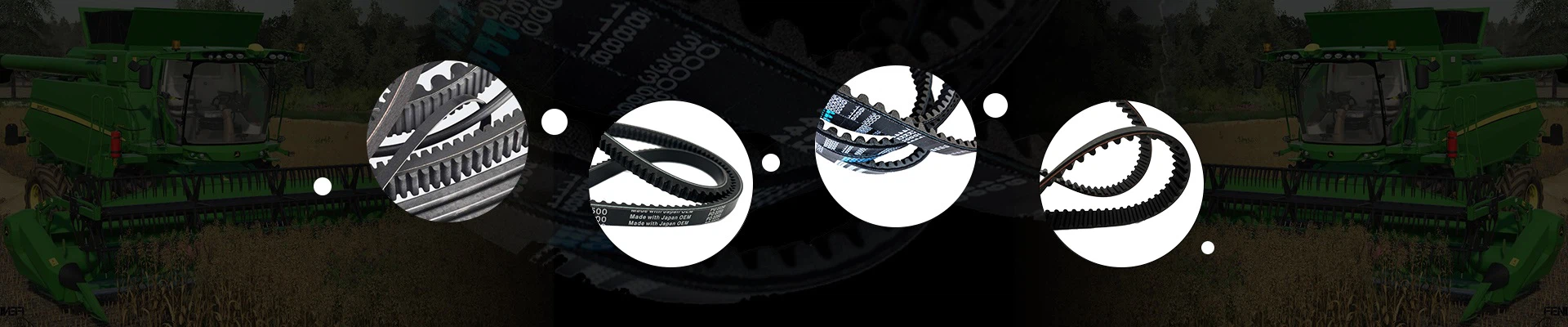
ROYALCORP: Your Professional Rubber V Belts Manufacturer
Rich experience: We have more than 20 years of experience in rubber belt manufacturing and can accept OEM and ODM business. Welcome to communicate!
Complete range of products: We professional produce and supplier all kinds of power transmission V-belts in cogged and classical version, rubber timing belt, pu timing belt , variable speed v belt, conveyor belt, applicate on vehicle, truck, tractor, passenger cars, scooters, light and heavy duty industrial machines, agricultural harvester machines, textile, food industrial machines, elevator, furniture , logistic transportation facility, hand tools, sport equipment, bank ATM and more.
High quality: We strictly execute ISO9001:2000 and ISO/TS16949 quality system. Assigned person in full-time to inspect during all the production procedure, never allowed unqualified semi-finished products were flow to the next process, we always strive towards 100% qualification rate of the products.
High quality service: Continues to expand and improve our group, to maximize the profit and value of customers and partners by providing first-class products and service, sincerely hope you can advise us more valuable comments.
Limited Time Promotion:First time customers can get 15% off. MOQ: 50pcs. Contact us now.
-

Stiff Cord V Belt
ROYALCORP stiff cord v belts are built for excellent performance. The belt cloth layer V with dedicated high-quality blend canvas, compression layer and layer selection done bending fatigue Add to Inquiry -
Hexagon V Belts
RoyalCorp Hexagon V Belts have technically good design and are economical for most ordinary drives. They are anti-static, oil and heat resistant and can be used in applications where belt linear Add to Inquiry -
Raw Edge Laminated V Belts
· RoyalCorp Raw Edge Laminated V Belts with the short-fiber impregnated rubber has excellent wear resistance to lateral pressure. · Available in wide angle and joined specifications, in addition to Add to Inquiry -
Ribbed V Belts PJ PK PL PM PH
RoyalCorp Ribbed V Belts PH, PJ, PK, PL, PM V-Belts contains unique, rubber compounds that are highly resistant to oil, heat and abrasion for longer life. The belts have a special truncated rib which Add to Inquiry -
Wrapped Type Classical V Belts
RoyalCorp Classical V BELT adopt scientific technical composition, specially selected first class rubber material and low elongation reinforce, our V-belt is comply with related international Add to Inquiry -
Perforated Adjustable V Belt
Perforated V Belt (V Belt with Holes) is a high-performance variant of the traditional V-belt, designed with precision-engineered holes or perforations along its length. These perforations Add to Inquiry -
Wrapped Banded V Belts
RoyalCorp Wrapped Banded V Belts give premium belt performance, just as do their single belt counterparts. The belts are constructed of the same highly engineered, high performance components as Add to Inquiry -
Raw Edge Cogged Banded V Belts
RoyalCorp Raw Edge Cogged Banded V Belts give premium belt performance, just as do their single belt counterparts. The belts are constructed of the same highly engineered, high performance Add to Inquiry -
Wedge V Belts
RoyalCorp Wedge V Belts give premium belt performance. The belts are constructed of the same highly engineered, high performance components. The components are manufactured using the latest in belt Add to Inquiry -
Variable Speed V Belts
RoyalCorp Variable Speed V Belts use with variable speed pulleys to gain a wide range of driven speeds. Provides exact speed control. Same high standard of quality in a replacement belt that we Add to Inquiry -
Wrapped and Cogged Kevlar V Belts
RoyalCorp Kevlar V Belts adopt scientific technical composition, specially selected first class rubber material and low elongation reinforce, our V-belt is comply with related international standard Add to Inquiry -
Raw Edge Cogged V Belts
RoyalCorp Raw Edge Cogged V Belts Specially Formulated Neoprene compounds withstand, extreme heat, dirt, grease, chemicals and environmental conditions. Replaced noisy, high maintenance chain and Add to Inquiry


CASE STUDY
Industry
Agriculture
Application
Centrifugal Irrigation Pumps (75 HP Motor)
Original Drive Description
Standard Rubber V-Belts
Problem
1. High-frequency failure: The humid and dusty field environment causes traditional rubber V-belts to age quickly, with cracking or stretching failure every 3 months on average
2. Energy waste: The slip rate is as high as 5%, causing additional energy loss to the motor (annual power consumption increased by 8,200 kWh)
3. Emergency maintenance costs: Sudden failures cause irrigation interruptions, each repair costs $350 (parts + labor), and downtime for 24 hours affects crop growth (loss $2,800/time)
4. Hidden costs: Belt debris contaminates the water pump bearings, increasing the annual bearing replacement cost by $1,200
Solution Drive Description
1. Three-layer anti-fatigue rubber structure: anti-ozone/moisture corrosion, life increased by 300%
2. Integrated sidewall stabilization belt: eliminate belt vibration, reduce slip rate to 0.5%
3. Embedded tension rope: prevent stretching deformation and maintain a constant transmission ratio
4. Tooth groove design: enhance heat dissipation and reduce operating temperature by 40℃
Benefits of ROYALCORP Drive
1. Maintenance savings: ($350 × 4 times/year × 3 years) - ($450 × 0.3 times/year × 3 years) = $3,795
2. Energy savings: 22,140 kWh × $0.12/kWh = $2,657
3. Downtime avoidance: $2,800/time × 4 times/year × 3 years = $33,600
4. Bearing maintenance savings: $1,200/year × 3 years = $3,600
5. Hidden benefits: Reduced risk of crop yield reduction (approximately $32,668, based on irrigation guarantee yield increase data)
Core Value Breakthrough Point
1. Environmental adaptability → Special rubber formula resists triple corrosion from field water mist/pesticide/fertilizer
2. Energy efficiency conversion → Reduced slip rate directly reduces motor reactive power consumption (in line with DOE energy-saving standards)
3. System protection → Integrated design eliminates resonance and extends the life of water pump bearings by 2.1 times
4. Agricultural clock management → Ensure zero interruption during critical irrigation windows to avoid claims for crop yield reduction
Our Factory
We are an integrated company with scientific research, production and trading. Established in 2001. With 20 years history and experience, take the advantage and resource of our factories, therefor allowed us to develop and service domestic and overseas market well. Our company located in the scenic Sanmen Bay, near to YONGTAIWEN and SHANGSAN highway, high-speed railway through Shanghai, Hangzhou, Ningbo and Wenzhou, the transportation is very convenient.

Our Certificate
We strictly execute ISO9001:2000 and ISO/TS16949 quality system. Assigned person in full-time to inspect during all the production procedure, never allowed unqualified semi-finished products were flow to the next process, we always strive towards 100% qualification rate of the products. From raw material purchasing to products delivering, we have complete inspection and testing equipment, and build a comprehensive monitoring system.


FAQ
As one of the most professional rubber v-belts manufacturers and suppliers in China, we're featured by good service and low price. Please rest assured to buy or wholesale high quality rubber v-belts for sale here from our factory. Contact us for customized service.
Raw Edge Cogged V Belts, Hexagon V Belts, Variable Speed V Belts