

Why Choose Us?
Rich experience: We are an integrated company with scientific research, production and trading. Established in 2001. With 20 years history and experience, take the advantage and resource of our factories, therefor allowed us to develop and service domestic and overseas market well.
Complete range of products: We professional produce and supplier all kinds of power transmission V-belts in cogged and classical version, rubber timing belt, pu timing belt , variable speed v belt, conveyor belt, applicate on vehicle, truck, tractor, passenger cars, scooters, light and heavy duty industrial machines, agricultural harvester machines, textile, food industrial machines, elevator, furniture , logistic transportation facility, hand tools, sport equipment, bank ATM and more.
High quality: We strictly execute ISO9001:2000 and ISO/TS16949 quality system. Assigned person in full-time to inspect during all the production procedure, never allowed unqualified semi-finished products were flow to the next process, we always strive towards 100% qualification rate of the products.
High quality service: Continues to expand and improve our group, to maximize the profit and value of customers and partners by providing first-class products and service, sincerely hope you can advise us more valuable comments.
Industrial Synchronous Belts
Industrial synchronous belt drives have teeth on the belt and corresponding grooves on the pulley wheels. The meshing teeth provide positive angular location and hence there is normally no relative motion or slipping between the two elements in mesh, giving a constant speed ratio between the driving and driven shafts. Rubber synchronous belts can therefore be used for applications such as automatic machinery where a definite motion sequence or indexing is necessary.
The principal dimensions of a industrial synchronous belt drive are the number of grooves, the pitch and the width. The belt pitch is the distance between two adjacent tooth centers measured on the pitch line of the belt. The belt pitch length is the total length of the belt measured along the pitch line.
-

Coated Rubber Synchronous Belts
RoyalCorp Coated Rubber Synchronous Belts are applied in many industrial applications, for example in the packaging industry, in the extrusion sector, for both light and heavy weight Add to Inquiry -
HTD Synchronous Belts
RoyalCorp HTD synchronous belt curvilinear tooth form ensures an optimized load distribution leading to high power transmission in low speed and high torque applications.. RoyalCorp 3M and 5M belts Add to Inquiry -
Double Tooth Synchronous Belts
RoyalCorp DOUBLE tooth Synchronous Belts gives you the proven performance of the RPP profile in double sided design providing maintenance-free synchronization from both sides of the belt on positive Add to Inquiry -
Superpower Timing Belt
Suitable for high speed and high load drive. Add to Inquiry -
Elastic Ribbed Belts
The elastic ribbed belt consists of a superstructure, an elastic tension cord and a base. The superstructure is made from a fibre-reinforced rubber mixture. The fibres are laid perpendicular to the Add to Inquiry -
Hightemp & Clean Timing Belt
Suitable for clean and high&low temperature environment. Add to Inquiry -
Super HK Timing Belt
Suitable for high torque and heavy load drive. Add to Inquiry -
ATM Part ATM Machine Parts 49229518000A 49229519000E
Supply of DIEBOLD, WINCOR,FUJITSU, GLORY and other ATM full range of ATM transport belt, mold complete,according to customer requirements to customize a variety of models. Add to Inquiry -
Coated V-belts
Top coated v-belts are fit for conveyer purposes. Top coatings are all welded (not glued)to ensure a strong and long lasting connection with the belt. Both the v-belt and the coating are truly Add to Inquiry -
Seamless Brown Timing Belt For Vertical Packaging Machine
Seamless Brown Timing belt are used in form fill seal machines to pull down plastic foil to form a pouch or a bag into which the product to be packed.The packets are gripped and drawn down by two Add to Inquiry -
ROYALCORP Silent Synchronous Belt
ROYALCORP Silent Synchronous Belt is an innovative double helix offset tooth drive .The spindle drive belt herringbone type offers very high performance in terms of noiselessness and precision, Add to Inquiry -
STS Synchronous Belts
RoyalCorp high torque STS synchronous belt. It performs both chain and gear drives and conventional synchronous drive systems. It's stronger, Cleaner, More quiet, More efficient, More compact, More Add to Inquiry


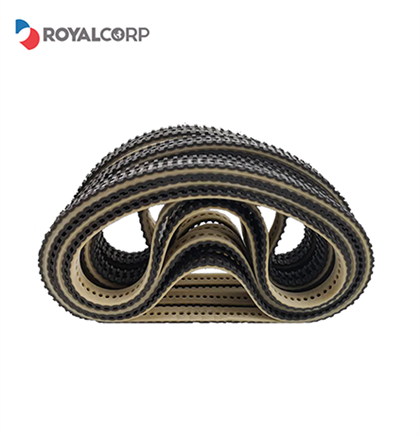


Advantages of Industrial Synchronous Belts
Industrial synchronous belts have several advantages compared to other types of power transmission belts such as round belts or v-belts. Some of the advantages include:
High speed: Industrial synchronous belts can operate at higher speeds than other types of belts, making them ideal for applications that require quick and efficient power transmission.
Efficient power transmission: Industrial synchronous belts are designed to transmit power with minimal loss, making them more efficient than other types of belts.
Durability: Industrial synchronous belts are made from durable materials such as leather, rubber, or synthetic materials, which makes them resistant to wear and tear. They are therefore perfect for usage in challenging industrial settings.
Reduced noise: Industrial synchronous belts operate quietly, reducing the level of noise in a manufacturing facility or industrial environment.
Versatile: Industrial synchronous belts can be used in a variety of applications, from high-speed machinery to conveyors and packaging equipment.
Positive drive: Industrial synchronous belts are designed to provide a positive drive, which ensures that the belt does not slip or lose power transmission.
Ease of installation: Industrial synchronous belts are easy to install and maintain, reducing downtime and maintenance costs.
No stretch: Industrial synchronous belts are designed to not stretch over time, which reduces the need for frequent tension adjustments.
Clean operation: Industrial synchronous belts do not generate debris or oil, making them ideal for use in clean environments.
Cost-effective: Industrial synchronous belts are generally more cost-effective than other types of belts, making them a cost-effective solution for power transmission needs.
Easy to customize: Industrial synchronous belts can be easily customized to meet specific needs and requirements, making them a versatile solution for a wide range of applications.
High strength: Industrial synchronous belts are designed to be strong and durable, making them ideal for use in heavy-duty industrial applications.
Industrial synchronous belts offer a number of advantages over other types of power transmission belts, making them a popular choice for a wide range of applications. Whether one are looking for a solution for high-speed machinery or a cost-effective way to transmit power, industrial synchronous belts are a reliable and versatile option.
Types of Industrial synchronous belt Profiles and Nomenclature
Industrial synchronous belt, also known as a timing belt, resembles a flat belt with evenly spaced teeth perpendicular to the belt's axis.
The belt teeth are designed to mash with pulley teeth, similar to chains. Timing belts do not rely on friction to transmit torque, instead, they rely on the positive engagement of belt teeth with the teeth on the sprocket. This results in minimal relative movement between the belt and the sprocket. Timing belts should be used where exact synchronization between driver and driven shafts is required. Timing belts are also available in dual-sided configurations. Dual-sided timing belts have teeth on both sides of the belt.
01
H-TYPE
The H-type tooth profile is referred to as HTD. It has a round tooth profile, and a group of radii defines its shape centered at a specific distance from the belt's pitch line.
It is available in 3mm, 5mm, 8mm, 14mm, and 20 mm pitches in various widths and lengths.
02
S-TYPE
The S-type tooth profile is referred to as STPD.
It is available in 3mm, 4,5mm, 5mm, 8mm, and 14mm pitches in various widths and lengths.
03
R-TYPE
The R-type industrial synchronous belt is an in-depth profile parabolic tooth design used in R-type.
It is available in 5mm, 8mm, 14mm, and 20mm pitches in various widths and lengths, in single-side and dual-side configurations.


How Industrial Synchronous Belts Are Made
The process of making rubber synchronous belts begins with selecting the type of rubber and reinforcing materials that will be mixed, molded, cured, cut, and joined. Industrial synchronous belts are made from natural rubber or synthetic rubbers with additives, such as cords, fabric coverings, and other features. The result of the process is a durable and reliable flat belt.
The selected materials for a flat belt are blended, heated, and placed in a mold under pressure to cure the rubber. Molds for manufacturing rubber synchronous belts are made of hardened steel and other forms of metal, with steel being the most common.
The key to manufacturing industrial synchronous belts is vulcanization, which changes the properties of rubber to increase its strength, elasticity, and durability. There are several forms of vulcanization, with all types using sulfur as an activation agent. The vulcanization process cross-links the rubber molecules to give a flat belt its tensile strength and resistance to stretching.
Once the rubber has cured, the mold is opened, and the cured belt is removed. It is then cut to the desired lengths and has its ends joined to form a continuous loop, a process that is completed using heat and pressure.
In addition to the basic process for making rubber synchronous belts, manufacturers may add additional features to improve belts' performance and longevity, such as coating the surface of the belt to increase its resistance to heat, oil, and abrasion. In addition, notches may be added to increase a belt's grip and prevent slippage.
Applications of Industrial Synchronous Belts
Industrial synchronous belts, also known as flat belt drive systems, are commonly used in industrial and mechanical settings to transmit power from one pulley to another. They are typically made from flexible and durable rubber or synthetic rubber and have a flat, smooth surface.
Power transmission by a flat belt can take many forms and are part of two pulley drives, including a drive pulley, a driven pulley, and a flat belt. A major feature of industrial synchronous belts is their ability to be customized to fit any application. For example, they can be designed with tracking sleeves or can have the coefficient friction adjusted to prevent slippage.
Textile machinery
Industrial synchronous belts are used in textile machinery to transfer power to spindles, needles, and other components. Textile industry rubber synchronous belts are used for a variety of applications within the textile industry, including power transmission, material handling, and process control. They are commonly used for driving and conveying equipment, such as spinning and weaving machines, calenders, and finishing machines.
In the textile industry, rubber synchronous belts are often preferred over round belts because they offer a larger surface area for carrying the load and they can be made in different widths and thicknesses to match specific requirements.
The key factors to consider when selecting industrial synchronous belts for the textile industry include the load to be transferred, the speed of the belt, the center-to-center distance between the pulleys, and the operating environment (temperature, exposure to chemicals, etc.). It is important to select a belt that is suitable for the specific conditions of the application to ensure optimal performance and long service life.
Some popular types of industrial synchronous belts used in the textile industry include leather belts, synthetic belts, and rubber belts. It is important to choose a belt material that is durable, flexible, and resistant to the specific conditions of the application.
Conveyors
Industrial synchronous belts are often used in conveyor systems to transport materials such as boxes, packages, and raw materials from one location to another.
Printing presses
Industrial synchronous belts are used in printing presses to transfer power from the motor to the printing cylinders.
Machine tools
In machine tools such as lathes, Industrial synchronous belts are used to transfer power from the motor to the cutting tools.
Industrial synchronous belts can be used in power transmission systems to transfer power from a motor to a machine, such as an agricultural pump or a generator.
4 Reasons to Consider Industrial Synchronous Belts

Prevent slippage
A problem with the traditional V-belt is that they are prone to slippage. In applications where input and output shafts need to be synchronised, slippage can result in a whole host of problems including spillage of materials, system blockage, and motor damage, and so needs to be keenly avoided. The positive engagement between the tooth profile on the belt and the pulley means that the potential for slippage is eliminated, enabling the synchronisation of shafts where it is required and bringing about other benefits as a consequence in applications where it is not.

Reduce maintenance
The correct tension is a key part of the operating requirements for V-belts that rely on friction to transmit power from a primary source to a secondary driven unit, rather than the meshing of teeth and grooves required of rubber synchronous belts. Following installation, the set level of tension in the latter tends to remain for a lengthy period of time, certainly longer than in v-belts where generally, tension must be frequently checked. In applications where a v-belt is changed for a rubber synchronous belt, users can enjoy the reduced amount of maintenance needed, saving them both time and money over the course of the product's service life. Rubber synchronous belts replacing chains also remove one of the main causes of wear (increasing maintenance intervals) and noise (increasing health and safety considerations for staff) in the latter. Instead of wrapping around the sprocket by means of articulated metal parts, they wrap around by flexion. This helps to prolong the belts' service life beyond that of regular transmission chain, and reduces maintenance burden throughout it.

Lessen impact on other components
Upon installation, rubber synchronous belts require only a low tension as they are wrapped around pulleys by means of flexion, and usually no retensioning thereafter. This means that, when compared to V-belts, less stress is applied on other components in the drive train like bearings and shafts. The unnecessary stress on bearings caused by belts being installed too tightly can lead to premature failure of the bearings as well as motors. This means that rubber synchronous belts provide peace of mind when it comes to the impact that the belt or chain are able to have on surrounding components.
Improve energy efficiency
Rubber synchronous belts suffer less energy loss than v-belts. In belt drives, energy loss is separated into two categories, torque loss and speed loss. The friction which v-belts depend upon generates heat, and this represents a source of torque loss, as does the amount of energy required to bend a generally thicker and heavier v-belt around a pulley. Thanks to the positive engagement principle that rubber synchronous belts use and their thinner cross-sections, less friction generates less heat in these belts and they also require less energy to flex around the pulleys in the driveline.
Speed loss is also a characteristic of V-belts, and this is a result of their tendency to slip. Generally speaking, V- belts elongate over time, hence the need for regular retensioning to avoid too much slip and maintain performance. Although properly maintained v-belt drives can run as high as 95-98% efficient on installation, it is accepted that this deteriorates by around 5% during operation. Those that have not been effectively maintained could be running up to 10% less efficient. In comparison, rubber synchronous belt drive systems remain at 98-99% over the entire life of the belt.
Considerations When Using Industrial Synchronous Belts
● Maintenance: Maintenance requirements refer to the cost of repairs or replacements.
● Noise level: The noise level generated by a rubber synchronous belts and its pulley system.
● Belt material: Selecting the right material for the job necessitates examining the environment, including temperature, humidity, and chemical exposure.
● Compatibility: The belt and pulley materials should be compatible to avoid slippage and failure.
● Cost: Cost is an aspect of every industrial purchase. When examining rubber synchronous belts, the initial cost may be high due to the type of material. However, if the selected materials are long-lasting, the cost can be amortized over the belt's lifespan (up to several years) before replacement. The cost of the replacement belt is another factor.
Our Factory
We are an integrated company with scientific research, production and trading. Established in 2001. With 20 years history and experience, take the advantage and resource of our factories, therefor allowed us to develop and service domestic and overseas market well. Our company located in the scenic Sanmen Bay, near to YONGTAIWEN and SHANGSAN highway, high-speed railway through Shanghai, Hangzhou, Ningbo and Wenzhou, the transportation is very convenient.

Our Certificate
We strictly execute ISO9001:2000 and ISO/TS16949 quality system. Assigned person in full-time to inspect during all the production procedure, never allowed unqualified semi-finished products were flow to the next process, we always strive towards 100% qualification rate of the products. From raw material purchasing to products delivering, we have complete inspection and testing equipment, and build a comprehensive monitoring system.


FAQ
As one of the most professional rubber synchronous belts manufacturers and suppliers in China, we're featured by good service and low price. Please rest assured to buy or wholesale high quality rubber synchronous belts for sale here from our factory. Contact us for customized service.
Rpp Synchronous Belts, HTD Synchronous Belts, Open End Rubber Synchronous Belts