
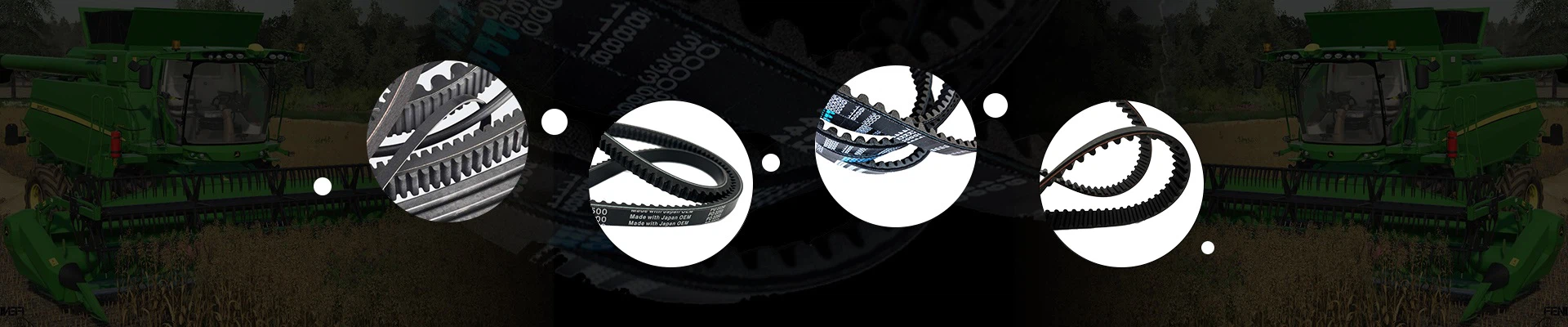
I. Differences in Design Intent and Application Scenarios
Automotive belts are specifically engineered for the demanding conditions of the engine compartment. Their primary function is to drive auxiliary engine components such as alternators, water pumps, air conditioning compressors, and power steering pumps. Common types include:
Timing belts: Requiring exceptional precision, these coordinate the crankshaft and camshaft to synchronise valve operation with piston movement.


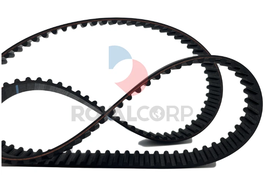

Multi-V belts: Combining the flexibility of flat belts with the grip of V-belts, they are frequently used to drive multiple accessories.


V-belts: Traditional yet reliable, employed for specific drive applications.
Their operating environment is extremely challenging, severely testing belt quality: high temperatures (close to the engine), oil contamination, intense vibration, and sudden temperature fluctuations.
Industrial belts encompass a wide variety, broadly referring to all transmission belts used in industrial production equipment. Their applications are extremely diverse:
Conveyor belts: Used for material transport in logistics, mining, food processing, packaging, and other industries.


Drive belts: Transmit power to various mechanical equipment, from textile machinery in factories to harvesters on farms.


Specialised belts: Such as food-grade conveyor belts or high-temperature resistant belts.


The core consideration for industrial belts is their adaptation to the specific physical and chemical environments of their industry, including resistance to wear, impact, corrosion, or hygiene requirements.
II. Key Focus Areas in Materials and Manufacturing Processes
Although both may utilise rubber (chloroprene rubber, nitrile rubber), polymers (polyurethane), or composite materials, their formulations and structures differ significantly.
Materials: Emphasis on heat resistance, oil resistance, fatigue resistance, and low noise. High-strength glass fibre or aramid (Kevlar) is commonly used as the tensile reinforcement layer to ensure dimensional stability.
Processing: Extremely stringent requirements for dynamic balance and dimensional accuracy, particularly for timing belts where tooth profiles must match perfectly; any deviation may cause severe engine damage.
Materials: Diversity is paramount. Emphasis may lie on abrasion resistance (mining), antistatic properties (electronics), hydrolysis resistance (humid environments), food-grade certification (FDA, EU standards), or flame retardancy (underground operations).
Processing: Structures may be substantially heavier depending on load and function. For instance, heavy-duty conveyor belts incorporate multiple fabric layers or steel cord cores to withstand immense tension and impact.
III. Technical Standards and Certification Systems
Automotive Belts: Must comply with stringent automotive industry standards and OEM certifications.
International standards such as ISO and SAE.
Must meet specific automotive manufacturer engineering specifications (e.g., Volkswagen, Toyota, General Motors' respective standards).
Quality management systems typically require IATF 16949 certification.
Industrial belts: Standards vary by industry and application.
General mechanical transmission may follow DIN, ISO, or RMA (Rubber Manufacturers Association) standards.
Specific sectors like food processing require compliance with sanitary regulations such as FDA or EU 1935/2004.
Mining belts must hold safety certifications like MSHA (Mine Safety and Health Administration).
IV. Market and Supply Chain Characteristics
Market: Closely tied to global automotive production and fleet size, divided into OEM (Original Equipment Manufacturer) and AM (Aftermarket) segments.
Supply Chain: Highly concentrated, with extremely high barriers to entry into OEM supply chains and lengthy qualification cycles; the AM market features intense brand competition and sensitivity to pricing and distribution networks.
Demand Characteristics: Relatively standardised specifications, but rapid model obsolescence necessitates continuous product line updates.
Market: Extremely fragmented, correlated with macro industrial investment and sector-specific economic conditions (infrastructure, mining, agriculture, food processing, etc.).
Supply Chain: Diverse, with customers ranging from equipment manufacturers (OEMs) to procurement departments of end-user factories.
Demand Characteristics: Customisation is commonplace, often requiring non-standard production based on equipment parameters (belt width, length, material). Customers prioritise durability, total cost of ownership, and technical support.
In essence, automotive belts are highly specialised 'special forces soldiers' engineered for engine applications, while industrial belts serve as versatile 'all-rounders' across diverse industrial battlefields. Their fundamental distinction stems from their design missions: one combats extreme conditions within confined spaces to safeguard mobility; the other carries power and materials across expansive production lines, driving the world forward.