
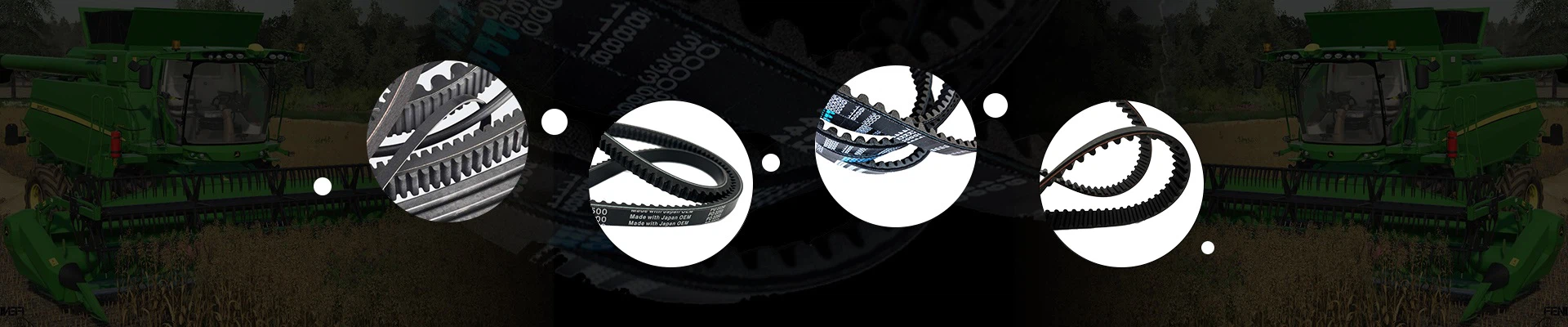
The main difference between cogged V-belts and classic V-belts is their design and application scenarios:
1. Tooth shape design:
Cogged V-belt: The working face is made into a V-shape, which has better adhesion and heat dissipation performance, and is suitable for high-speed operation and the need for high transmission efficiency.

Classic V-belt: Its cross-section is rectangular, relying on the friction between the belt and the pulley for transmission, suitable for general low speed and medium speed transmission.

2. Application field:
Cogged V-belt: Because of its excellent performance, it is especially suitable for high-speed, precision manufacturing and high-speed operation industries, such as automotive, aviation and so on.

Classic V-belt: widely used in a variety of mechanical drives, especially in the need for larger torque transmission and higher transmission ratios.
3. Performance characteristics:
Cogged V-belt: it can reduce sliding at high speed, improve energy transfer efficiency, have good heat dissipation performance, and extend service life.

Classic V-belt: Perform well in low and medium speed drives, with overload protection and cushioning, but can face wear and slip problems at high speeds.
4. Maintenance and use:
Cogged V-belt: Due to design optimization, it has low maintenance requirements and is suitable for equipment with limited space.

Classic V-belt: The tension needs to be checked and adjusted regularly to maintain the stability and efficiency of the drivetrain.
To sum up, toothed V-belts and traditional V-belts have obvious differences in design, application, performance and maintenance. Toothed V-belt is more suitable for high-speed, high-power transmission occasions, while the traditional V-belt is suitable for general low speed, medium speed transmission needs. In the selection, should be based on the specific application scenarios and requirements of the balance.