
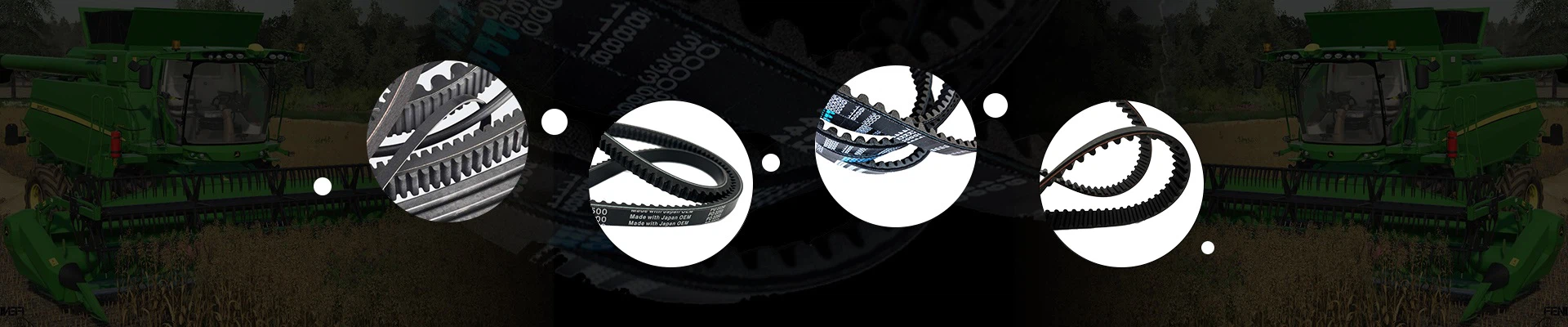
To achieve precise adaptation of all variable speed V-belts for harvester combine, there is no need to blindly compare equipment brands. Strictly follow the authoritative agricultural machinery standards GB/T 14829-2018, lock in four core quantitative dimensions: size parameters, belt structure, power operating conditions, and weather resistance to prevent adaptation errors.

1. Accurately Verify Core Dimensional Parameters (Basic Adaptation)
Precise dimensional consistency is the fundamental prerequisite for stable transmission and normal matching between variable-speed V-belts and pulley sheaves. Per national standard specifications, three core matching parameters must be strictly controlled: top width, belt height, and reference length.
GB/T 14829-2018 defines independent tolerance ranges for different belt cross-sections and length grades. Excessive dimensional deviation will directly cause asymmetric belt tension, operating slip, eccentric abrasion, and premature fatigue fracture. To ensure accurate model adaptation, selection should first refer to the official parameter specifications provided by the original equipment manufacturer. If factory technical documents are unavailable, field measurement of the reference dimensions of the original belt is required. Special non-standard specifications can be customized within the national standard tolerance range to meet individual equipment adaptation requirements.
2. Select Belt Structure According to Harvester Load Characteristics
According to the structural classification of agricultural machinery variable-speed transmission belts specified in GB/T 14829-2018, two mainstream structural types are adopted for harvester variable-speed V-belts: wrapped V-belts and cut-edge V-belts. The two structures possess distinct performance characteristics and apply to different load scenarios.
Wrapped V-belts feature an outer rubber fabric layer, providing stable dust resistance and wear resistance, and are suitable for small and medium-sized harvesters operating under light and medium load conditions. Cut-edge V-belts adopt smooth side-face design without outer wrapping fabric, delivering better heat dissipation performance, higher transmission efficiency, and superior flexibility and impact resistance. This structure is more applicable to high-power, heavy-duty combine harvesters with frequent high-speed and high-load operation.
The standard cross-section series for agricultural variable-speed V-belts specified in the official national standard (HG, HH, HN, HO) fully covers mainstream variable-speed transmission configurations of commercial combine harvesters.
3. Match Belt Specifications with Equipment Power and Operating Conditions
Variable-speed V-belt selection must be matched with the harvester's rated power, spindle operating speed, and actual field working conditions. The working condition coefficient is referenced according to agricultural machinery transmission design conventions: a coefficient of 1.0 applies to flat-field normal harvesting conditions, while a coefficient of 1.2 to 1.5 applies to hilly and mountainous areas with frequent starting, stopping, and intermittent impact loads.
Low-power compact harvesters operating under mild working conditions can adopt standard variable-speed V-belts. For medium and high-power harvesters or equipment working under complex mountainous and heavy-load conditions, reinforced variable-speed V-belts are required. Reinforced structural design effectively suppresses tensile deformation under alternating heavy loads, ensures stable power transmission, and avoids operational failures such as belt slipping and transmission interruption.
4. Adapt to Complex and Harsh Farmland Operating Environments
Combine harvesters continuously operate in open farmland environments characterized by high temperature, dust, humidity, oil contamination, and sand abrasion. Selected variable-speed V-belts must meet the environmental durability requirements specified in national agricultural machinery standards.
Qualified agricultural variable-speed V-belts comply with the test requirements of ISO 1813 for conductive and anti-static performance, reducing static electricity accumulation risks caused by grain dust during harvesting operations. The rubber compound maintains stable mechanical properties within the conventional operating temperature range for agricultural field equipment. Standardized oil resistance and thermal aging resistance tested in accordance with GB/T 14829-2018 enable the belt to adapt to diverse climatic and soil conditions across northern and southern farmlands, achieving significantly longer service life compared with ordinary general-purpose transmission belts.
Cross Section Dimension of Royalcorp's Variable Speed V Belts for Harvester Combine
| DRAWING | TYPE |
CORD WIDTH(bp)
|
TOP WIDTH(b)
|
HEIGHT(h) | ANGLE(a) |
AVAILABLE LENGTH RANGE |
|
| WRAPPED | COGGED | ||||||
|
|
HZ | 8.5 | 10.0 | 6.0 | 40° | 450~6000MM | 400~8000MM |
| HA | 11.0 | 13.0 | 8.0 | ||||
| HB | 14.0 | 17.0 | 11.0 | ||||
| HC | 19.0 | 22.0 | 14.0 | ||||
| HD | 27.0 | 32.0 | 19.0 | ||||

| DRAWING | TYPE |
CORD WIDTH (bp)
|
TOP WIDTH (b)
|
HEIGHT (h)
|
HEIGHT ABOVE
|
AVAILABLE LENGTH RANGE |
|
| WRAPPED | COGGED | ||||||
|
|
HG | 15.4 | 16.5 | 8 | 2.5 | 800-6000MM | 500-8000MM |
| HH | 19.0 | 20.4 | 10 | 3.0 | |||
| HI | 23.6 | 25.4 | 12.7 | 3.8 | |||
| HJ | 29.6 | 31.8 | 15.1 | 4.7 | |||
| HK | 35.5 | 38.1 | 17.5 | 5.7 | |||
| HL | 41.4 | 44.5 | 19.8 | 6.6 | |||
| HM | 47.3 | 50.8 | 22.2 | 7.6 | |||
| HN | 53.2 | 57.2 | 23.9 | 8.5 | |||
| HO | 59.1 | 63.5 | 25.4 | 9.5 | |||
