
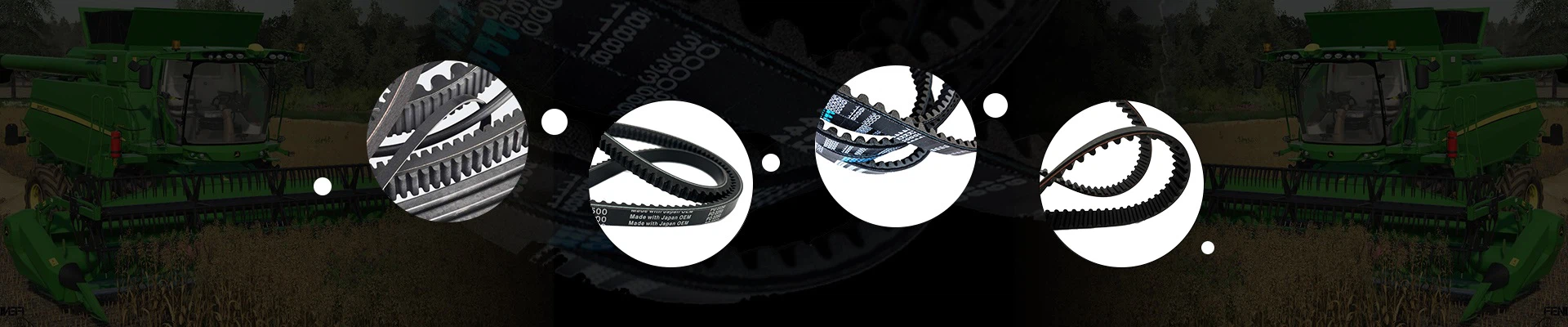
The durability of lawn mower belts depends on the choice of materials and structural reinforcement. While rubber is still the basic choice due to its flexibility, polyester cords increase tensile strength, and Kevlar fibers perform excellently under high-stress conditions-commercial operators report that Kevlar belts can be used continuously for up to 200 hours before showing wear.

Rubber, Polyester, and Kevlar: Comparing Material Wear Resistance
Standard rubber belts break down fastest under friction, losing 15–20% of their thickness every 100 hours of operation in field tests. Polyester-reinforced belts, with woven cord construction, reduce this wear rate by 40%. Kevlar's heat-resistant polymer outperforms both, maintaining 90% of its structural integrity even after 300 hours in zero-turn mowers.
Advantages of Aramid Cords and Composite Reinforcements in Heavy-Duty Belts
Aramid fiber cores resist stretch better than steel cables, stretching only 0.3% under a 250-pound load. Composite belts with fiberglass layers dissipate heat 50% faster than single-material designs, which is crucial for preventing glaze buildup during long summer mowing sessions.
Choosing Reinforced Mower Belts for Frequent Use
Match belt structure to workload:
- <50 hours/season: Rubber-polyester hybrids
- 50–200 hours: Aramid-reinforced gear V-belts
- Commercial use: Composite belts with fiberglass/Nomex® layers
Always check pulley alignment-even a high-end belt will wear 30% faster if the deck parts are misaligned.