
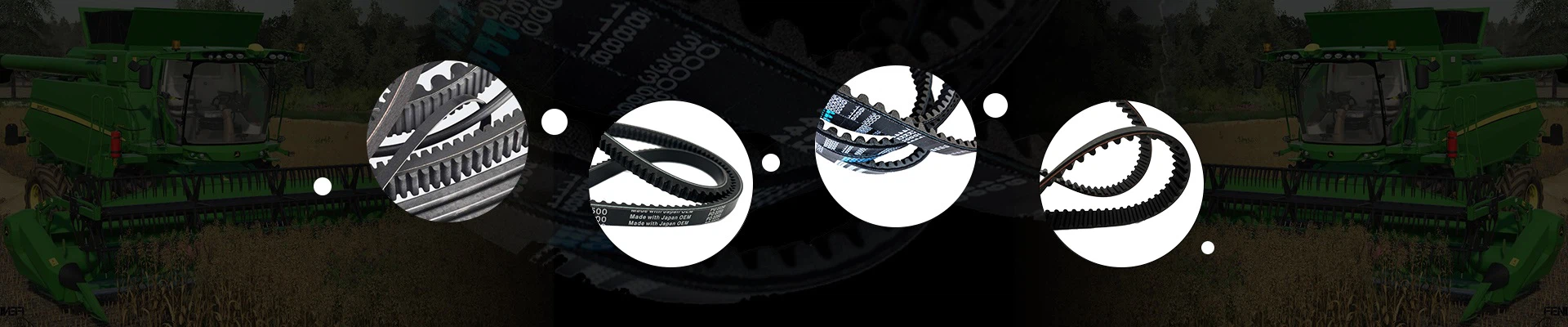
The multi-ribbed structure of the Poly V belt resolves issues of slippage under heavy loads and the tendency to veer off the pulley. Each rib collectively achieves exceptional power transmission.


1. Significantly increased contact area
This represents the most notable advantage. The core principle of the Poly V belt lies in bonding multiple micro V-belts into a single flexible belt body. Each wedge groove interlocks precisely with the corresponding pulley groove, creating multiple contact points rather than a single point. This substantially increases the contact area, enabling the belt to generate greater friction and grip under the same tension. Consequently, Poly V belts can achieve high-power transmission without slippage at higher tension levels, or deliver equivalent power transmission at reduced tension. This approach alleviates bearing loads and minimises energy loss.
2. Exceptional Flexibility and Compactness
The thin-ribbed cross-section endows the Poly V belt with remarkable flexibility. Utilising extremely thin material thickness and minimal rib spacing, each rib can flex independently. The belt can run over pulleys with extremely small diameters, enabling engineers to design more compact and lightweight drive systems. This flexibility also makes it ideal for drive systems requiring back-side idler pulleys, where the belt's reverse side contacts a smooth pulley.
3. Uniform Tension Distribution and High Stability
The Poly V belt's design ensures precise operation without slippage or derailment, alongside uniform wear. Its broad, flat base provides excellent lateral rigidity, preventing the belt from twisting or flipping within pulley grooves. Simultaneously, tension is evenly distributed across all ribs. Consequently, the belt operates with precision, minimising vibration and whipping. This stability delivers smoother running, lower noise levels, and more uniform wear across all ribs, maximising belt service life.
4. Efficient Heat Dissipation
Power transmission generates heat, a primary adversary for rubber and polymer materials. The grooves between ribs are not mere voids. They substantially increase the belt's surface area, creating greater space for heat dissipation. Simultaneously, they channel airflow, generating a natural cooling effect during operation. Consequently, the belt's operating temperature is reduced, slowing the ageing process of elastomeric materials such as rubber or polyurethane. This directly extends service life while maintaining stable performance under demanding conditions.


The ribs of Poly V belts achieve synergistic benefits through coordinated action: increased contact area enhances grip, high flexibility enables compact design, inherent stability ensures reliable operation, and efficient cooling prolongs service life.