
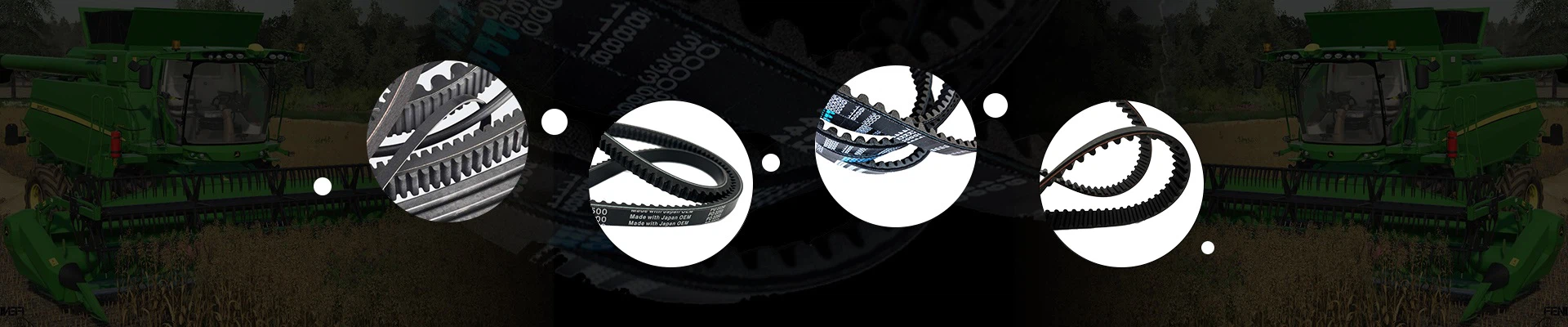
I. Design Structure: Precisely Optimised Transmission Contact
Traditional V-belts employ a trapezoidal cross-section design, transmitting power through contact between the inclined sides and pulley grooves. This design has inherent limitations: limited contact area, with transmission efficiency typically ranging between 90–95%; when multiple V-belts are used in parallel, length variations can easily cause uneven load distribution.
Serpentine belts employ a flat base design with multiple micro-V wedges embedded along the underside.


This innovative structure delivers multiple advantages:
·Contact area increases by over 40%, with each wedge making independent contact with the pulley, significantly enhancing friction
·Stress distribution becomes more uniform, eliminating excessive wear at single points
·Superior flexibility enables efficient operation on pulleys with smaller diameters
II. Performance Comparison: Dual Enhancement in Efficiency and Stability
|
Performance Metrics |
Conventional V-belt |
Serpentine Belt |
Advantage Margin |
|
Transmission Efficiency |
90~95% |
90~95% |
3~8% improvement |
|
Speed Ratio Range |
Standard |
Wider |
Accommodates more operating conditions |
|
Vibration Resistance |
Moderate |
Excellent |
Reduces vibration by over 30% |
|
Space Occupancy |
Larger |
Saves 30~50% space |
More compact structure |
|
Service Life |
Standard |
Extended by 20~40% |
Lower maintenance costs |
III. Application Advantages: Meeting Diverse Modern Industrial Demands
1. Outstanding Energy-Saving Performance
The serpentine belt's high transmission efficiency directly translates to energy conservation. For instance, a continuously operating 75kW motor can save approximately 3,000–5,000 kWh annually after switching to serpentine belts, with an investment payback period typically under six months.
2. Compact Design with Exceptional Adaptability
The serpentine belt's slim profile and lateral flexibility enable outstanding performance within space-constrained modern compact machinery. For equivalent power transmission, serpentine belt systems occupy over 30% less space than V-belt systems.
3. Simplified Maintenance with Reduced Costs
·Zero-adjustment design: Superior dimensional stability minimises tensioning requirements
·Single-belt replacement: No need for batch replacements as with V-belts
·Pre-assembled kits: Integrated pulley solutions reduce installation errors
4. Smooth Transmission with Low Noise
The multi-wedge structure of serpentine belts ensures continuous contact with pulleys, delivering smoother transmission and noise reduction of 5-10 decibels compared to traditional V-belts. This makes them particularly suitable for noise-sensitive working environments.
IV. Recommended Industry Applications
Based on our export data, serpentine belts demonstrate most significant replacement benefits over V-belts in the following sectors:
·Automotive industry: Engine accessory drive systems (air conditioning compressors, water pumps, alternators)
·HVAC systems: Large ventilation equipment, cooling tower drives
·Food processing machinery: Applications requiring frequent cleaning and moisture resistance
·Textile machinery: High-speed, smooth transmission requirements
·Mining machinery: High-load, continuous operation in harsh conditions
V. Selection and Procurement Recommendations
When selecting serpentine belts, consider the following parameters:
·Number of wedge bars (PK, PJ models, etc.): Determines transmission capacity
·Material composition: Temperature and oil resistance properties of polyurethane, neoprene, etc.
·Antistatic requirements: Conductive properties for specialised environments
·Dimensional accuracy: High-quality serpentine belts achieve length tolerances within ±3mm/metre
As a specialised export supplier, we advise clients to provide:
·Original belt model or dimensions
·Transmission power and rotational speed requirements
·Operating environment conditions (temperature, humidity, oil exposure, etc.)
·Spatial constraint parameters